


EXECUTIVE SUMMARY
- U.S. federal government debt has ballooned over the last decade and now exceeds $35 Trillion. Nearly one-third of today’s accumulated debt has been added since Q1 2020.
- Ongoing annual budget deficits, high debt service costs, demographic trends, and a noticeable lack of credible policy proposals from the major political parties suggest a future in which U.S. economic growth, fiscal flexibility, and crisis response are materially constrained by cumulative government debt.
- Investors with ultra-long-term or inter-generational financial goals should revisit their portfolio strategies and incorporate the likely constraints and risks arising from the growing government debt burden.This may require reframing the role of investment-grade bonds, equity-oriented investments, and real assets in goals-based investment portfolios.
The accumulated debt outstanding of the U.S. federal government has burgeoned over the last ten years and now exceeds $35 Trillion. Nearly one-third of today’s Total Public Debt has been added since Q1 2020, as the chart below from the St. Louis Fed’s FRED database shows:
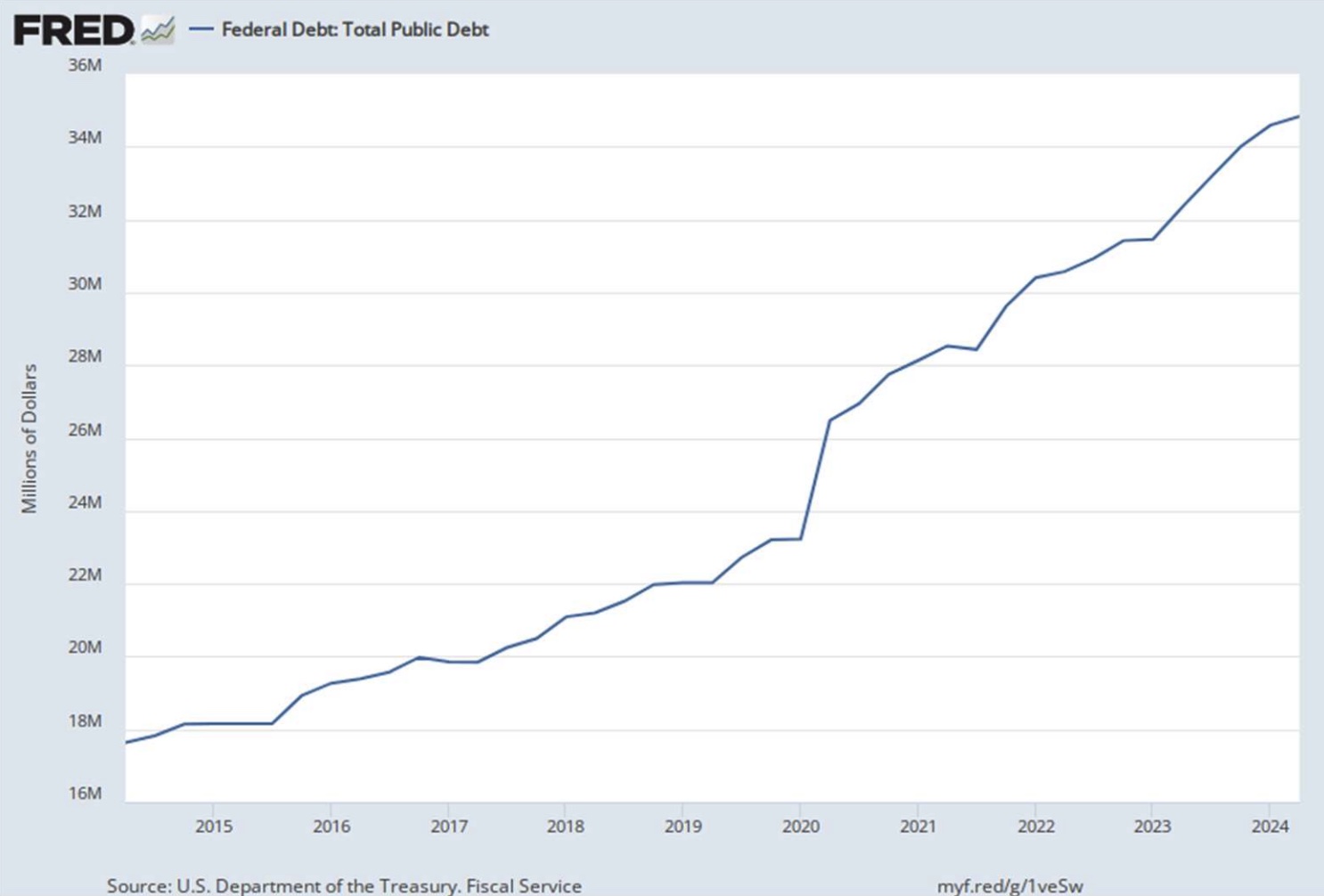
Alarming though this chart may appear, Total Public Debt excludes the actuarial present value of entitlements for which the Federal government is also obligated: Social Security, Medicare, and Medicaid being the largest. These “Mandatory Outlays” in the U.S. budget totaled $3.75 Trillion in fiscal year 2023 alone, a number which is expected to grow predictably over the next three decades due to rising health care costs and well-known demographic trends.1
To most of us, the absolute level of government debt ($35T!) appears ominous, but is it equally alarming when viewed on a relative basis?
- Relative to annual national income, federal Total Public Debt now stands at roughly 123% of U.S. GDP, having been only 56% of GDP at the turn of the Millenium (gray-shaded areas indicate periods of economic recession):
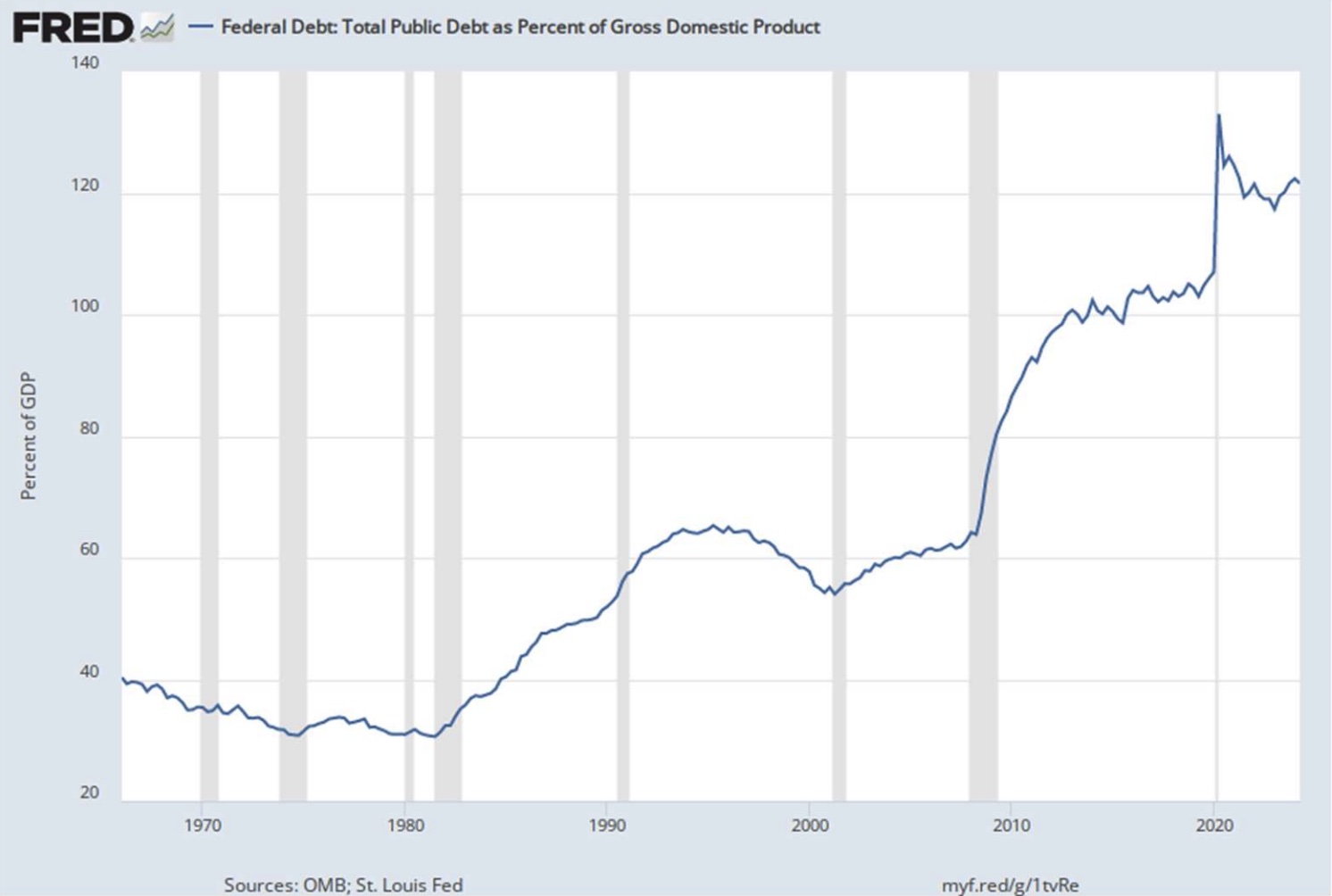
- Relative to fellow G-7 developed economies, the U.S. government’s Total Public Debt-to-GDP ratio (123%) is higher than that of Germany (64%), France (112%), Canada (105%), and the UK (104%), but lower than that of Italy (139%) and Japan (255%).2 Perhaps understating the obvious, the U.S. Treasury Department has noted, “Generally, a higher Debt to GDP ratio indicates a government will have greater difficulty in repaying its debt.”3
- Relative to the total annual government budget, interest costs incurred on the debt have taken up a progressively larger share over time. According to the U.S. Treasury Department, the share of the federal budget attributable to Net Interest Expense is roughly 13% in fiscal year 2024, up dramatically from 8% in 2020 and around 3% in fiscal year 2000.4
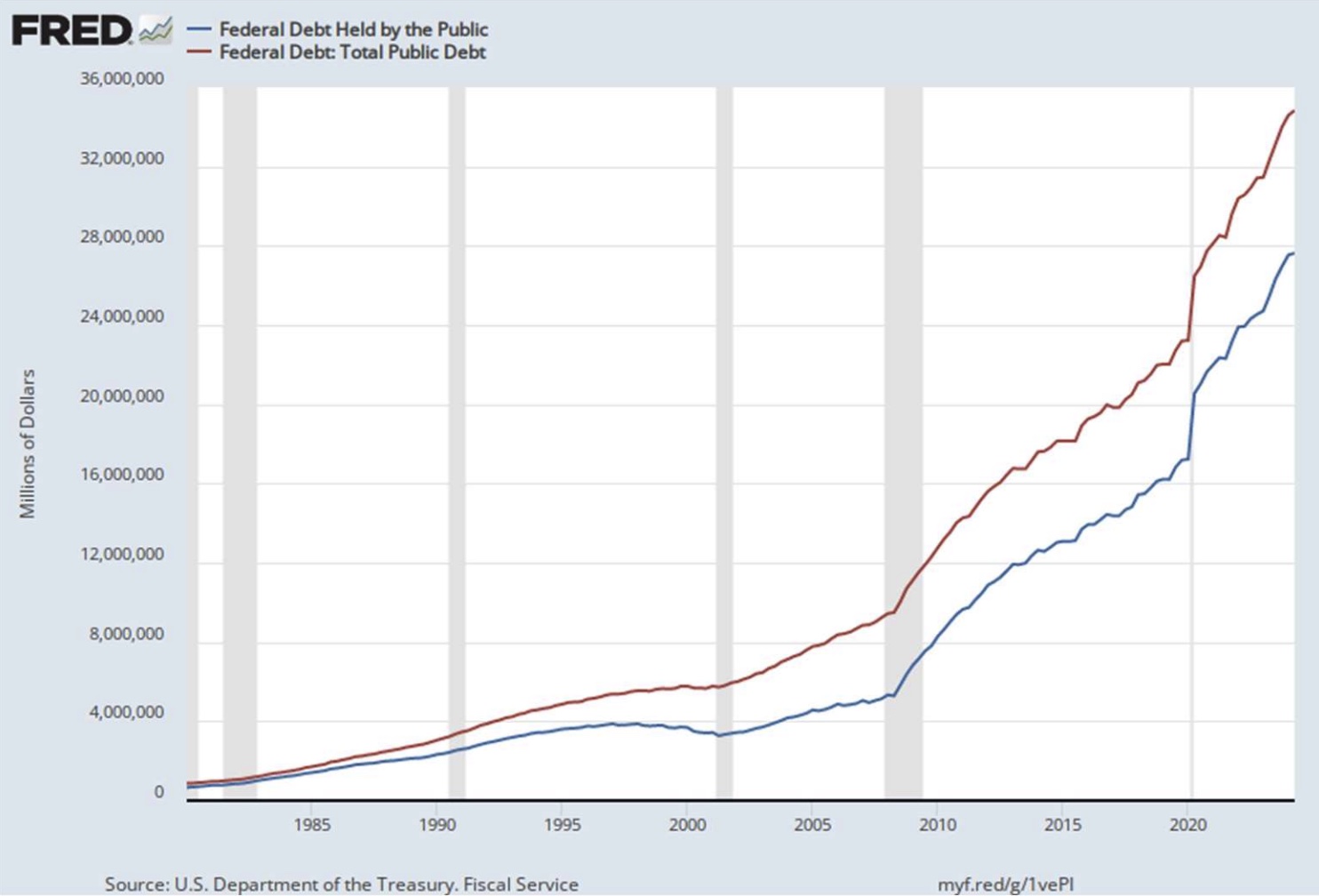
Note to reader: In the charts and citations above, we have elected to use Total Public Debt as our measure of the accumulated federal debt. Total Public Debt (~ $35T currently) includes U.S. government debt held by the Federal Reserve via its program of Quantitative Easing (~$7T) and by other intergovernmental agencies. A different measure known as Federal Debt Held by the Public excludes intergovernmental holdings on the grounds that the related assets held and liabilities owed cancel each other on the U.S. government’s consolidated balance sheet. The Congressional Budget Office (CBO), cited below, tends to utilize the narrower Federal Debt Held by the Public measure in its forecasts. We prefer the broader measure which highlights the expanded role played by the Federal Reserve in recent years in government bond markets. Federal Debt Held by the Public totaled $27.6T in Q3 2023, having risen by roughly 60% from $17.2T in Q1 2020. Both measures are shown in parallel below:
Near-Term Debt Outlook
Total Public Debt already exceeds $35T and the Congressional Budget Office forecasts government budget deficits in the range of $2.0T to $2.4T for each of the next 10 years, adding well more than $20T to the federal debt by 2034.5 Given those alarming figures, voters might expect these issues would occupy center stage in the 2024 election campaigns. Yet neither of the major U.S. political parties nor their respective presidential candidates offer a credible plan for balancing the annual budget deficit or meaningfully reducing the accumulated government debt. A recent headline in THE WALL STREET JOURNAL proclaimed:
“Federal Debt is Soaring. Here’s Why Trump and Harris Aren’t Talking About It”6
The article bemoaned, “…the country’s fiscal trajectory merits only sporadic mentions by the major-party presidential nominees, let alone a serious plan to address it.Instead, the candidates are tripping over each other to make expensive promises to voters.”7
A newly published study by the Committee for a Responsible Federal Budget agrees, “…neither major candidate running in the 2024 presidential election has put forward a plan to address this rising debt burden. In fact, our comprehensive analysis of the candidates’ tax and spending plans finds that both Vice President Kamala Harris and former President Donald Trump would likely further increase deficits and debt above levels projected under current law.”8
In a different political environment, proposed solutions to the Federal debt problem might cluster around one of four broad approaches, each of which brings its own practical constraints and risks:
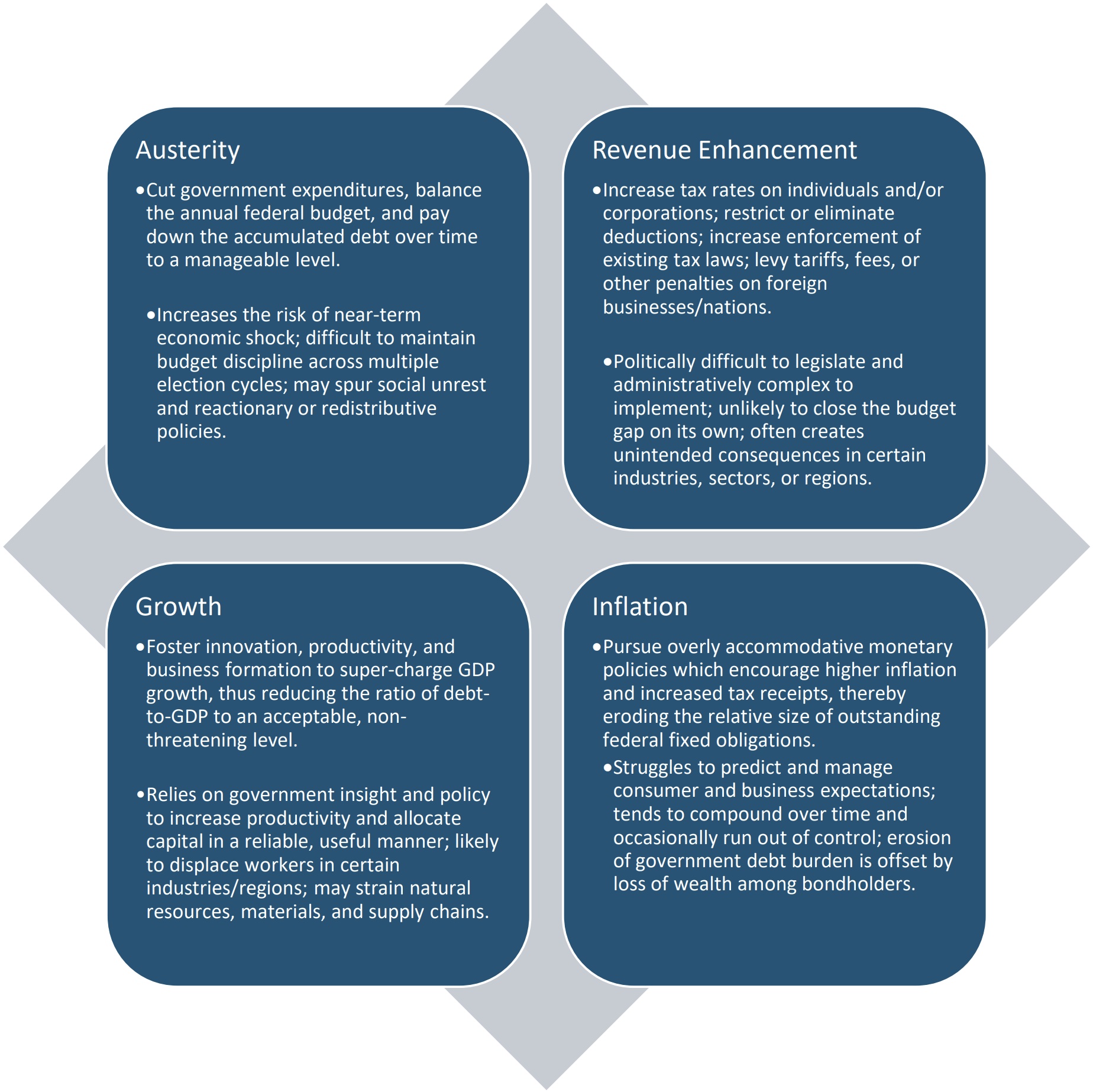
Arguments for or against any of these four approaches typically emanate from philosophical beliefs regarding the role of government, equity and fairness in society, and the balance of near-term vs. longterm national interests. In today’s highly fractured and volatile political climate, we see little in the way of pragmatic policy proposals from either political party or presidential candidate. In our opinion, the odds are extremely high that the federal debt burden will grow materially over the next decade. In fact, it is difficult to envision the set of circumstances which would lead to a decline in government debt in the near term.
Long-Term Debt Outlook
Looking beyond the next decade, the government debt picture remains bleak. In a well-researched, reader-friendly publication titled The Long-Term Budget Outlook: 2024-2054 (March 2024), the non-partisan Congressional Budget Office (CBO) suggests both absolute and relative measures of U.S. federal debt are likely to worsen over the next thirty years:
“If current laws governing taxes and spending remained unchanged, the federal budget deficit would increase significantly in relation to gross domestic product(GDP)over the next 30 years. That increase would stem primarily from high and rising interest costs and from large primary deficits(that is, deficits excluding net outlays for interest).From 2024 to 2054, growing deficits would push federal debt held by the public far beyond any previously recorded level.”9
The CBO report then offers a lengthy (and somewhat depressing!) list of potential negative outcomes which could result from chronic, advanced government indebtedness:
“If Federal debt continued to increase in relation to GDP at the pace that CBO projects it would under current law, it would have far-reaching implications for the nation’s fiscal and economic outlook. The large and growing debt would have many consequences, including the following:
- Borrowing costs throughout the economy would rise, reducing private investment and slowing the growth of economic output.
- Rising interest costs associated with that debt would drive up interest payments to foreign holders of U.S. debt and thus decrease national income.
- The risk of a fiscal crisis—that is, situation in which investors lose confidence in the value of the U.S. government’s debt—would increase. Such a crisis would cause interest rates to rise abruptly and other disruptions to occur.
- The likelihood of other adverse outcomes would also increase. For example, expectations of higher inflation could erode confidence in the U.S. dollar as the dominant international reserve currency.”
- The United States’ fiscal position would be more vulnerable to an increase in interest rates, because the larger the debt is, the more an increase in interest rates raises debt-service costs.
- Lawmakers might feel constrained from using fiscal policy to respond to unforeseen events or for other purposes, such as to promote economic activity or strengthen national defense.”10
The CBO report wisely avoids pinpointing a specific level of accumulated debt that might spawn a sudden fiscal crisis for the U.S. government or loss of confidence in the U.S. Dollar. Instead, the CBO notes “…it is the government’s cost of servicing the debt and its ability to refinance that debt as needed that matter. Among the factors affecting servicing costs and the ability to refinance are investors’ expectations about the outlook for the budget and economy, and expectations about domestic and international financial conditions, including interest rates and exchange rates.”11
The heightened need to periodically refinance government debt is a function of the large pre-existing balance of debt outstanding and ongoing annual budget deficits. When an already-highly-indebted borrower continues to run annual budget deficits, the borrower’s accumulated debt will inevitably rise and the ability to refinance existing and new debts on acceptable terms will become a paramount need. And, as the CBO report asserts, the ability to refinance depends partly on “investors’ expectations” about a complex matrix of domestic and global financial variables. Both those financial variables and the expectations of global investors are very difficult to predict and even harder to manage. This reality, among others, is why there is danger in relying on the “ability to refinance” in longterm financial planning for governments, businesses, and households.
Gradually and then Suddenly
In economics, it is generally assumed that individuals and households prefer their standard of living (i.e., consumption, or spending) to remain roughly stable from year to year. The acts of saving and borrowing are viewed as two means of smoothing out consumption over time. When we forego consumption today and instead add to our savings, those dollars saved today increase our capacity to consume at later dates, while dollars spent today reduce our capacity for future consumption. If some portion of today’s spending is funded by borrowing, there is a doubly negative effect on our ability to spend in the future since we must repay not only the amounts originally borrowed but also the interest on our debts.
Viewed thusly, the dramatic growth of the U.S. government debt outstanding ($35 Trillion) in recent years represents an intertemporaltransfer of economic value, or spending power. Spending capacity was transferred (and continues to accumulate via interest expense and ongoing deficit spending) from future years into each of those earlier years in which the government ran a fiscal deficit. The pressing question is not: “Will past deficit spending and the related cumulative debt constrain future consumption and growth?” The answer is: “Yes, it must.” The more relevant question is: “How, when, and to what degree of severity will these constraints be felt by consumers, taxpayers, and investors?”
In The Sun Also Rises (1926), Bill Gorton and Mike Campbell discuss the latter’s financial difficulties in Ernest Hemingway’s typically brusque language:
“How did you go bankrupt?” Bill asked.
“Two ways,” Mike said.
“Gradually and then suddenly.”
To be clear, we are not suggesting the United States government will “go bankrupt” in any commonly understood sense of that phrase. Neither the Congressional Budget Office nor the Committee for a Responsible Federal Budget suggest our government’s financial collapse is on the horizon. Instead, we believe the odds are the U.S. government debt burden will become progressively more constraining to economic growth and policy flexibility including the ability to respond to crises—economic, military, natural, & social—as they arise.
Progressively tighter constraints on growth and policy flexibility are the “gradually” in Hemingway’s conversation, i.e., the first of Mike’s “two ways.” One example of a “gradually” tightening constraint involves changes in consumer behavior in response to ballooning government debt: households may adjust downward their personal spending and increase their rate of savings to offset the expected implications of the Federal government’s indebtedness. While this might be a completely rational response to worsening government debt, such a trend would further restrain economic growth.
Another example relates to the so-called “neutral” interest rate, the level of interest rates at which monetary policy is balanced between the tradeoffs of full employment and price stability. In an environment of continuously growing government debt, the “neutral” rate of interest may plateau at a higher level than would otherwise be the case. This would drive up the cost of capital for U.S. consumers, businesses, and the federal government itself. A higher cost of capital—all other things being equal—drives down the value of productive assets and makes future projects under consideration less rewarding for the risks assumed.
In an environment where interest rates reside at a higher plateau than expected, the biggest borrower— the U.S. government—certainly would suffer from higher annual interest costs. The Federal Reserve might be obliged to practice “yield curve control” in which it actively suppresses interest rates below their natural level to allow the government to service its debt more comfortably. One prominent fixed income manager noted recently that the Fed had implemented such a policy in the 1940s and 1950s to help the government repay its war-related debts and predicted, “By manipulating interest rates across various maturities, the Fed could curb rising borrowing costs for the government, tempering the escalation of interest expenses.”12 He further notes, “Recently, the Bank of Japan (BoJ) has deployed a similar tactic, with the central bank holding around 50% of total Japanese Government Bonds outstanding, indirectly monetizing Japan’s exorbitant debt…”13It is unclear when, by what means, and with what impact the BoJ might extricate itself from this policy regime.
The second way of Mike Campbell’s financial peril—“and then suddenly”—may revolve around the need to constantly refinance the ever-growing debt. Throughout the calendar year, the U.S. Treasury holds auctions of bills, notes, and bonds to fund both the short-term and longer-term needs of the government. In recent years, concern has emerged over the possibility of a “failed auction” in which the Treasury Department is unable to place all its offered securities at the expected rate of interest, thus necessitating a spike in yields or intervention from the Federal Reserve (as in March 2020).14
Given the important role of U.S. Treasury markets in facilitating systemic liquidity, transaction processing, hedging, and driving capital costs for both businesses and households, a failed auction or prolonged spike in Treasury yields could “suddenly” create a turning point. The risk of acute recurring liquidity crises may rise in money and capital markets as the Treasury Department expands debt issuance, potentially overwhelming available capital, and elected officials recurringly debate the implications of “government shutdown.”
Global investor demand for U.S. Dollar and the government’s Treasury bills, notes, and bonds could remain relatively strong in the near term, then erode over the longer time horizon. At present, no other government-sponsored paper money can credibly claim to serve as the world’s reserve currency, with all that would entail. While the United States certainly enjoyed an “exorbitant privilege”15in the post-War era—the ability to print paper money and have it treated as equivalent to gold—this privilege does not come without cost or risk. When economists reference the “Triffin dilemma,”16 they remind us that strong global demand for the recognized reserve currency (presently the U.S. Dollar) can force the sponsoring nation (the United States) to run persistent trade deficits as a means of supplying other nations with their desired holdings of the reserve currency. Over time, imbalances of trade, savings, and debt may accrue, gradually putting downward pressure on the value of the reserve currency. The “and then suddenly” phase for the U.S. Dollar and Treasury securities might be connected to a failed Treasury auction, to a dramatic change in U.S. government policy (e.g., taxes, tariffs), to a military or geopolitical event (e.g., invasion of Taiwan by China), or to a financial “accident” or systemic glitch.
Impact on Investment Strategy
We suggest that investors with ultra-long-term or inter-generational financial goals re-envision future economic and financial scenarios, incorporating the likely constraints and risks arising from the growing government debt burden. Such an exercise may lead to reframing the traditional role of certain asset classes and investment strategies in goals-based portfolios, including investment-grade bonds, equity-oriented investments (public and private), and real assets.
There are innumerable combinations of future variables, constraints, and risks which could be modeled and around which we might reposition investment portfolios. For the sake of illustration (and brevity), we will focus on three sample scenarios involving chronic and worsening U.S. government debt:
- Slow Growth Scenario: Economic growth in the U.S. is constrained by the government debt burden; Real GDP growth averages 1-2% annually; Artificial Intelligence (AI) proves to be a useful tool but requires significant capital investment and creates job insecurity for some workers; interest rates remain 100-200 basis points higher than the slow-growth environment typically would suggest; the government debt burden grows steadily and predictably.
- Inflationary Scenario: Nominal GDP growth remains relatively robust (4-5%) but inflation exceeds the Fed’s 2% target by 1-2% on average and periodically spikes for several years as major fiscal policy initiatives are added by elected officials; monetary policymakers struggle to balance the conflicting goals of full employment & price stability and to manage expectations of future inflation; business owners, corporate executives, and households alike find the environment difficult for planning and risk-taking.
- Financial Instability Scenario: Unexpected extraneous events (e.g., natural disasters, military actions, epidemics) combine with high government debt/decreased fiscal flexibility to force the U.S. Treasury to borrow at uneconomically high rates of interest; the Federal Reserve is forced to intervene (as it did in the GFC and COVID eras) to provide emergency liquidity and/or prevent yields from rising further; highly levered businesses or investment strategies run the risk of failure; foreign investors seek alternative transactional and reserve currencies to the U.S. Dollar; government debt-to-GDP matches or exceeds the high end of the CBO’s forecast range.
Each of these scenarios creates different winners and losers among asset classes and investment strategies. One might attempt to construct a matrix of all investable assets and estimate their likely performance in each of the scenarios described above. Yet none of the three scenarios can be expected to unfold in linear fashion over the next 30 years. A more useful approach, we believe, is to consider several reasonable coping strategies for investors living in the era of chronic government debt:
- Consider utilizing duration-matched investment-grade bonds to fund near-term goals. Since the U.S. government is likely to flood the bond market with trillions of dollars in additional debt over the next decade, bond investors would be prudent to consider whether the traditional role and management approach for bonds remains ideal. Goals-based investors might consider duration-matching their investment-grade bond holdings to those high-priority financial goals requiring funding over the next 1-7 years. By closely matching the duration of fixed income exposures and goals, the potentially negative effects of rising interest rates, falling bond prices, and constrained bond market liquidity are minimized. If U.S. Treasury securities are utilized (and the investor’s goals are denominated in U.S. Dollars), then credit risk and currency risk are also mitigated. There are two mechanical ways to accomplish this, the choice of which will depend on investor-specific circumstances: in the more literal method, laddered bond portfolios can be constructed using U.S. Treasury or high-quality municipal bonds in dollar amounts and maturities purposely aligned to the dates and dollar amounts of specific client goals. In a more diversified method, a broad portfolio of investment-grade bonds can be constructed such that the weighted-average duration of bond holdings is matched to the weighted-average duration of near-to-intermediate-term goals. Properly constructed, both approaches can mitigate investor worries about daily bond market volatility.
- Tilt Public Equity exposures toward sectors and companies able to perform well against the likely economic and financial headwinds. Whether one’s primary worry relates to the Slow Growth, Inflationary, or Financial Instability scenario, an investor navigating the era of constraining government debt is likely to benefit from investing in the stocks of:
- companies which can maintain attractive gross and net margins even when commodity prices, materials costs, and labor rates are rising faster than expected.
- companies with strong balance sheets and forward-looking capital structures that facilitate low, stable capital costs even as interest rates rise and competitors find capital scarce.
- companies able to deploy capital to transformative technologies efficiently and profitably.
- Add geographic diversification to offset U.S.-specific risks. Among the G-7 developed economies, the United States has been the clear winner in terms of economic growth, employment, and equity market returns since the onset of COVID in early 2020. Over the Trailing 5 Years ending September 30, 2024, the U.S. large-cap equity benchmark S&P 500 Index earned an average annual return of +16.0% while the MSCI EAFE Index tracking 21 developed markets in Europe, Australia, and the Far East returned only +8.2% annually. The U.S. is arguably well positioned to continue its economic dominance in future years, but significantly cheaper valuations (P/E ratios) in both developed and emerging markets equities suggest an opportunity to diversify portfolio risk without significantly compromising expected return. The performance of emerging markets equities has been especially weak over the Trailing 5 Years: +5.7% annually for the MSCI Emerging Markets Index. Yet long-term demographic trends—population growth, expansion of consumer spending & the middle class, and a lower debt burden than in past decades—favor emerging economies. Overall, a country or region immune to economic and financial problems is nowhere to be found, yet we believe that fact does not imply that substantially all our portfolio risk ought to be tied to the U.S. economy and financial markets. Geographic diversification is especially important if we believe the U.S. Dollar’s status as the primary global reserve currency will erode as the government debt burden grows.
- Earn an illiquidity premium via private investments and maximize “optionality” in selecting private strategies. If the dour projections of the Congressional Budget Office and other economists materialize, the U.S. Treasury will soak up a growing share of available investment capital to fund ongoing budget deficits and refinance ballooning government debt. In this context, the “neutral” rate of interest may elevate and the risk premium for illiquid, private assets also may widen as investors demand higher remuneration for tying up their capital for 5-10 uncertain years. Goals-based investors having a capital surplus (assets greater than the present value of financial goals) will occupy a privileged position in this scenario, since they can commit capital to private investments and earn the expanded illiquidity premium without jeopardizing their ability to fund high-priority, near-term goals. In terms of selecting specific private investments, investors should seek to maximize “optionality,” that is, to gain exposure to an array of transformative technologies, new or expanded markets, and innovative business models. Venture Capital strategies focused on one or more of these exposures are less likely to be limited by the headwinds of government debt and slow growth than are Buyout/LBO or Growth Equity private investments.
- Allocate a portion of the portfolio to Real Assets. Investments in Real Assets (aka tangible assets, hard assets) such as real estate, energy, infrastructure, commodities, and precious metals typically outperform Financial Assets (cash, stocks, & bonds) during inflationary periods. This is largely intuitive and many of us have witnessed the correlation first-hand during and immediately following the COVID pandemic (especially in our own personal real estate values). As the prices of materials, components, and labor rise, the value of certain hard assets tends also to increase since they have an intrinsic physical value derived in part from the price of their components and their supply is constrained by natural resources available, distance & transportation costs, and supply chain functionality. We caution investors, however, to conduct the same due diligence and exercise the same level of capital discipline in selecting specific Real Assets for investment that they would exercise in selecting other managers. Often wealthy families succumb to the temptation to over-invest or allocate capital inefficiently to personal residential property, farmland and sporting properties, or collections of art, automobiles, watercraft, or aircraft under the guise of “it’s a good investment.” Owning these assets can enhance lifestyle and help in achieving non-financial goals, but oftentimes families find it difficult to segregate the “lifestyle value” from the true investment value. Similarly, investors should consider the form in which Hard Assets might be held in their investment portfolios, recognizing that holding assets directly (e.g., physical gold) may be optimal for investors worried about collapse of the global financial system, whereas investing via Exchange Traded Funds (ETF), futures contracts, or interval funds may be more appropriate for investors seeking to profit from rising prices but unworried over systemic collapse. Investors contemplating allocation to Real Assets should begin by asking “For what reason or ultimate purpose are we allocating a portion of our assets to gold (or land, or energy, or infrastructure)?
There is no “one size fits all” portfolio adjustment or ideal combination of adjustments which can be suggested for all investors of all life stages, all asset levels, and all risk tolerances. In addition, tax considerations will play a part for many investors in determining how best to reposition portfolios. What is important, in our opinion, is to begin considering and discussing today the trajectory, impact, and possible mitigants of the expanding government debt.
We also encourage goals-based investors to actively manage the “other side of the balance sheet” as a means of coping with chronic government debt. Personal financial goals—needs, wants, and aspirations—can be viewed as self-imposed liabilities on the family balance sheet. In addition, many families may have actual liabilities—mortgages, business loans, embedded capital gains taxes, charitable pledges—that must be paid at some future date. Understanding how the government’s growing debt burden drives the amount and timing of these self-imposed and actual liabilities via inflation, interest rates, and tax rates is as important as understanding the implications on our asset allocation.
Summary
It is tempting to throw up our hands and conclude that the ever-growing federal government debt burden is an unsolvable, existential economic problem. That temptation is exacerbated by today’s volatile political environment. We reiterate our conviction: there is a high probability the U.S. government debt burden will become progressively more constraining to economic growth and policy flexibility including the ability to respond to crises—economic, military, natural, & social—as they arise. These constraints will tighten “gradually” over time “and then suddenly” trigger risk events or reach tipping points that may be particularly detrimental to the U.S. Dollar, Dollar-based financial assets, and America’s global status. No individual investor or family can totally escape the constraining effects of the federal debt burden, but individual investors can remain alert to the likely constraints and risks and reframe the role of certain asset classes and investment strategies. Only by periodically reviewing and refining their financial goals and adjusting portfolio exposures appropriately can investors learn to live with chronic government debt rather than being ruled by it.