


EXECUTIVE SUMMARY
- U.S. equities declined in Q1 2025, reversing a portion of their 2024-25 gains. Mega-cap technology stocks led the decline. Trump’s tariff announcements on April 2 triggered a further major selloff in global equities.
- Several risks in our Matrix of Major Portfolio Risks have intensified, including the risk of spiraling trade wars, depressed consumer/business/investor sentiment due to policy volatility, and slowing economic growth.
- We recommend that multi-generational investors continue to maintain broadly diversified portfolios appropriately aligned with their goals and cashflow requirements and resist the temptation to practice “market timing” in this volatile environment.
- Volatile financial markets may create opportunities for employing certain financial planning and wealth structuring strategies additive to long-term family wealth.
Review of Q1 2025 & Early April
Financial markets reversed course in the First Quarter of 2025 as U.S. equities gave back a portion of the substantial gains they had enjoyed in recent years. In fact, several of the very mega-cap technology stocks that propelled the S&P 500’s gains in 2023 and 2024 were hardest hit in Q1 2025. After lagging for years, international equity markets finally outperformed U.S. stock indices, and investment-grade bonds were additive to portfolio returns in Q1.
The table below contrasts Q1 2025 and the Last 5 Years (annualized) performance for selected market indices and each of the “Magnificent Seven” mega-cap tech stocks:
| Equity Index | Q1 2025 | Last 5 Years |
| S&P 500 Index | -4.3% | +19.7% |
| Russell 2000 Index | -9.5% | +14.9% |
| MSCI All-Country World Index Ex-U.S. | +5.2% | +11.5% |
| MSCI EAFE Index (Developed Mkts) | +6.9% | +12.4% |
| MSCI Emerging Markets Index | +2.9% | +8.5% |
| “Magnificent Seven” Stocks | ||
| Alphabet | -18.2% | +21.8% |
| Amazon | -13.3% | +14.3% |
| Apple | -11.2% | +29.2% |
| Meta | -1.5% | +28.3% |
| Nvidia | -19.3% | +75.2% |
| Tesla | -35.8% | +49.3% |
| Barclays U.S. Aggregate Bond Index | +2.8% | -0.4% |
Two days after quarter-end, President Trump made his long-expected announcement of reciprocal tariffs on goods imported into the United States. The reaction of equity markets the following day (April 3) was extremely negative: the tech-heavy NASDAQ fell by -6.0%, the S&P 500 declined -4.8%, and the Dow lost -4.0%. From their respective 12-month highs to the April 3 market close, the NASDAQ, S&P 500, and DJIA declined by -18%, -12%, and -10%, respectively. International equity markets also declined after Trump’s announcement on worries that specific countries, industries, and companies will be particularly affected by tariffs and/or a slowing of overall economic growth in the coming months.
The equity market selloff continues (as of Noon, April 4), with equity indices currently down -2% to -4% today. The yield on 10-Year Treasuries has declined precipitously to the sub-4.0% level as analysts assign a higher probability to multiple rate cuts by the Fed in 2025 and risk-averse investors shift capital to safer assets. This morning’s monthly jobs report indicated a strong job market, though the bulk of recent government job cuts will be included in next month’s report.
Risk Environment & Outlook
As we turn our focus to the remainder of 2025, we continue to note the myriad risks facing businesses, consumers, and investors. Back in January, we created the Matrix of Major Portfolio Risks shown below as a tool for distinguishing the sources of risks (Financial vs. Policy) and the time horizons (Near-Term vs. Long-Term) over which they might impact investment portfolios. In the current version of our Matrix, we highlight in red those risks that have intensified in recent weeks:
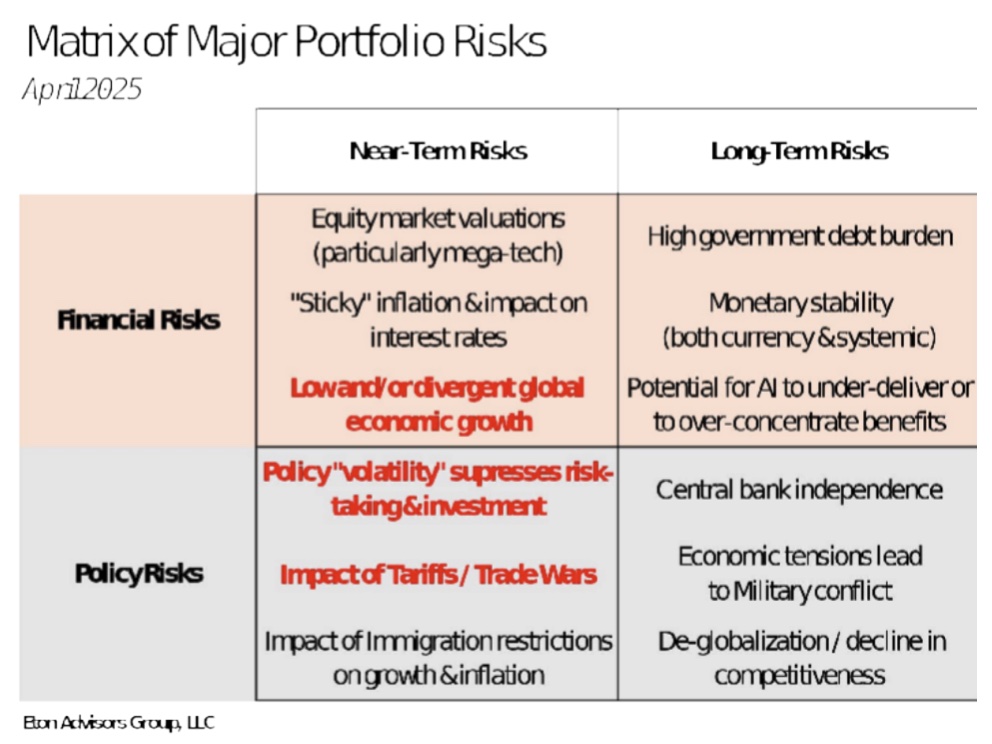
Focusing specifically on the three elevated risks highlighted above, the global economy and financial markets risk being caught in a self-reinforcing downward cycle wherein:
- reciprocal tariffs act as a “tax” on consumer spending, which constrains what has been the primary engine of GDP growth in the U.S.
- businesses respond to tariff uncertainty and the potential pullback in consumer spending by reducing capital investment and hiring
- the Federal Reserve feels constrained by the potential inflationary impact of tariffs and does not follow through with 3-5 rate cuts in 2025 as analysts currently expect
- investors across the globe maintain their current “risk off” stance, and equity markets remain well below their January levels for the balance of the year
- the Trump administration is unable to deliver on its promised tax cuts due to the tumultuous policy and market environment
In this environment—the pain of tariffs is clearly felt but the promised benefits and other mitigating policies have yet to materialize—a primary risk is that the U.S. economy slips into recession in mid-year 2025. Near-term rate cuts by the Federal Reserve, an indication that the Trump administration is willing to negotiate on tariffs, and delivery of promised tax cuts could mitigate both an economic recession and investor pessimism.
An investor could be tempted to believe that certain risks have lessened recently: For example, has the recent selloff in equity markets reduced the Near-Term Risk related to Equity market valuations (particularly mega-tech) listed above? It is true that stock prices have declined in recent weeks, which, all things being equal, could reduce the risk of stock market overvaluation. But tariffs and related uncertainty may also cause forward corporate earnings to decline proportionally or more. Further negative re-adjustments in equity prices may occur in the coming weeks, especially in sectors where earnings growth is highly sensitive to tariff policies.
The same is true with the Long-Term Risk of High government debt burden. President Trump and his economic advisors tout increased tariffs and the proposed “Mar-a-Lago Accord” as effective means of addressing the government’s $36+ Trillion Federal debt outstanding. Setting aside philosophical considerations for the moment, the process by which tariff policy has been formulated, announced, and implemented suggests a low probability that a cohesive, permanent solution to the government debt burden will be implemented without stoking the risk of financial “accidents” along the way.
Portfolio Positioning
In the current environment of numerous risks and day-to-day spikes in market volatility, how should investors position their portfolios?
- We will continue the ongoing, dynamic process of reviewing and updating your family’s goals, cash flow needs, and asset allocation. Eton’s Goals-Based Analysis seeks to maximize the probability of achieving each family’s specific goals, accounting for the specific priority- levels and time horizons of each goal. Your portfolio’s strategic asset allocation targets are the output of this process and serve as the foundation for allocating capital and managing portfolio risk during periods of market volatility.
- We recommend that multi-generational investors continue to maintain broadly diversified portfolios appropriately aligned with their goals and cashflow requirements. Though equity markets have sold off dramatically, other asset classes have maintained or added value to portfolios this year: cash, investment-grade bonds, many relative-value hedge funds, and certain commodities exposures. Investment-grade bonds, for example, have benefitted from the sharp decline in 10-Year Treasury yields in 2025 and are currently up +3.4% for the Year-to-Date.
- We encourage long-term, multi-generational investors to resist the temptation to practice “market timing” in this volatile environment. The Goals-Based process indicates the appropriate asset allocation targets for achieving family goals, including the required level of liquid assets to avoid forced asset sales at market lows.
- Market volatility may serve as an opportunity for financial, tax, and estate planning. Strategies such as mortgage/debt refinancing, tax-loss harvesting, and strategic gifting of assets that have declined in value may be especially attractive for some families. We are monitoring and discussing these opportunities and will be in touch with you as appropriate for your unique circumstances.
We will continue to monitor the evolving policy landscape and related market volatility present in this uncertain time. Meanwhile, please feel free to contact us with your thoughts, comments, and questions.