


EXECUTIVE SUMMARY
- The Third Quarter 2025 witnessed continued geopolitical tensions, military conflicts, domestic political turmoil, and tariff uncertainties.
- Nonetheless, public equity markets looked past these risks and rose in Ǫ3 on steady U.S. economic growth and the promise of Artificial Intelligence (AI) to grow productivity and corporate profits.
- The U.S. Federal Reserve cut its policy interest rate by 25 basis points in September and indicated additional cuts may be forthcoming.
- At quarter-end, the U.S. Government shut down non-essential operations while Congress debated competing budget proposals. While the shutdown may not be protracted, the risk of policy “accidents” certainly has increased.
- Given the risks described and unexpectedly strong equity returns year-to-date, we suggest investors trim global equity overweights (where feasible given tax constraints) and maintain adequate liquidity to weather a near-term market correction, should it occur.
Review of Ǫ3 2025
Despite the volatile geopolitical and domestic environments, returns on major market indices were uniformly positive in Ǫ3:
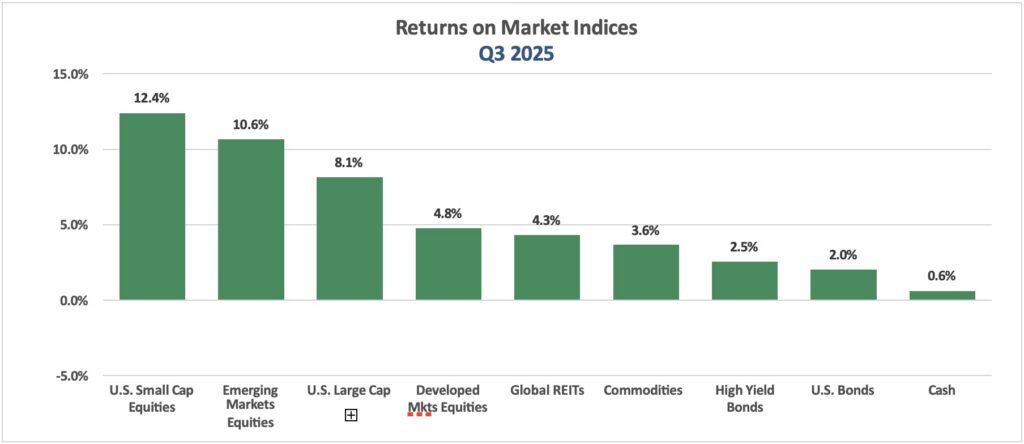
- The lessening of recession fears in the U.S. and heightened optimism about AI’s role in bolstering productivity and corporate profits were primary drivers of equity market returns in Ǫ3. These two factors are closely connected:
- The Economist reports nearly $400 billion is being invested by U.S. companies this year on infrastructure needed to run AI models and “…by the end of 2028 the sums spent worldwide on data centres will exceed :3 Tr.”i
- Such outsized levels of corporate investment into AI-related projects have “juiced” U.S. GDP in recent periods. Economist Jason Furman asserts, “The AI-related investment expansion is like a fiscal expansion,”ii and suggests more than 90% of the growth in U.S. GDP in the first half of 2025 is attributed to capital spending by businesses on tech-related projects.
- The hyperscalers funding the bulk of AI-related capital expenditures (e.g., Microsoft, Meta, Amazon, Alphabet) expect commensurately outsized growth in revenue, productivity, and future corporate earnings. Current equity valuations reflect this AI-driven optimism.
- The Federal Reserve cut its policy interest rate by 0.25% on September 17, setting the Fed Funds rate at 4.00 – 4.25%. Federal Open Market Committee (FOMC) members projected another 1-2 rate cuts before year-end and a Fed Funds rate of 3.10% at the end of 2027.
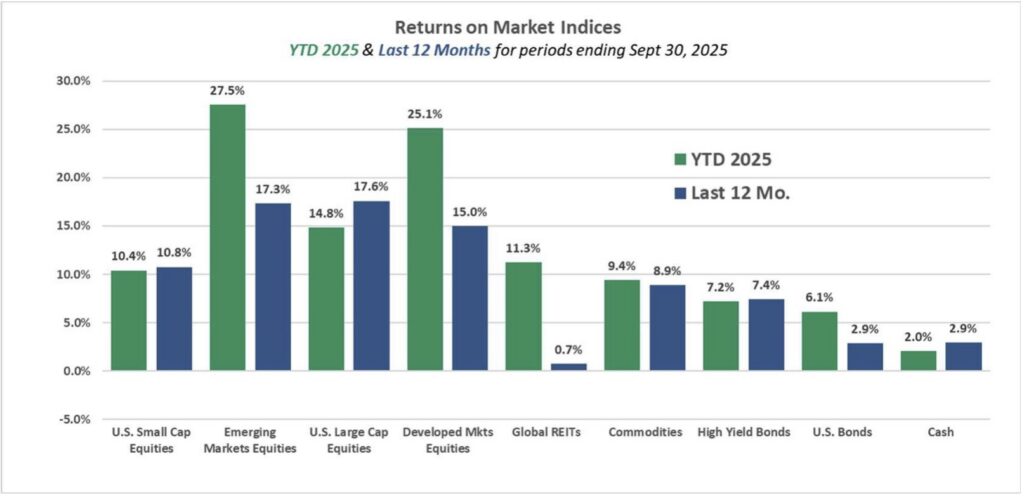
Many investors began 2025 expecting flat or negative equity returns for the calendar year, but Year-to-Date and Last 12 Months returns show quite the opposite:
Market Outlook
Since equity markets have posted unexpectedly positive returns in recent quarters while global risks remain fully in force, it is natural for investors to question whether an equity market correction is on the horizon.
- The FINANCIAL TIMES headline “Is the AI boom a bubble?”iii exemplifies the daily stream of commentaries questioning whether Artificial Intelligence will, in fact, supercharge productivity growth and corporate profits as promised.
- AI skeptics compare the current boom to the Dot-Com Bubble (1999-2002) or warn of the dangers of relying on AI spending to fuel U.S. economic growth (such as in the FT’s clever headline: “GDP – AI = 0.”iv) In this view, were the AI spending boom to falter, so would U.S. economic growth.
- Others counter “this time is different,” since tech companies are far less leveraged today and the technology sector operates as a more mature and predictable industry than at the turn of the millennium.
- Eton’s view is somewhere in between: the benefits of AI will be tangible and widespread, we believe, but over-investment in the sector may drive down expected returns to some capital providers.
- Future Fed rate cuts—even if they materialize as expected—might not provide a strong tailwind to consumer spending, housing, or equity valuations. Further rate cuts by the Fed in Ǫ4 2025/1H 2026 are unlikely to reduce 10- or 30-year rates.
- October’s shutdown of the U.S. government reminds us of the risks of persistent U.S. budget deficits and the growing government debt outstanding including the potential for supply/demand imbalances and future liquidity crises in Treasury markets. The shocking climb in gold prices—up nearly 50% in the first 9 months of 2025—illustrates the level of worry among investors over U.S. indebtedness.
Portfolio Positioning
Geopolitical and domestic policy uncertainty, volatility, and risk are likely to remain features of the investment landscape during Ǫ4 2025 and 1H 2026.
- Were the AI spending boom to falter or its promises fall short of expectations, a equity market correction might occur either as a one-time market selloff or via sub-par equity market returns for the next 3-5 years. Such a correction should be viewed as normal and healthy, if it occurs in an orderly fashion.
- Recently enacted tariffs—which have increased the effective rate on goods imported to the U.S. from roughly 3% to 16%—have not produced much of the widely predicted negative impacts on U.S. economic growth or inflation. We maintain, however, that it is premature to give the “all clear” signal and believe investors should remain cautious on the longer-term effects of tariffs.
- Given the risks described and unexpectedly strong equity returns year-to-date, we suggest investors trim global equity overweights (where feasible given tax constraints) and maintain adequate portfolio liquidity to weather a near-term market correction, should it occur.
- Liquidity management and diversification are key to investor success in this uncertain environment. The ability to sustain risk exposures during difficult markets—via adequate liquidity to fund near-term needs, prudent constraints on financial leverage, and rebalancing to avoid overconcentration—dramatically improves one’s chances of achieving long-term goals.