


EXECUTIVE SUMMARY
- Proposed tariffs, multiple military conflicts, and ongoing policy uncertainty dominated headlines in Ǫ2 2025, spurring daily market volatility.
- After a sharp equity market correction in April, equities rebounded strongly in May/June, with international equities outperforming U.S. stocks. Bond returns were slightly positive for the quarter.
- At quarter-end, debate raged over Trump’s proposed tax and spending bill (which was signed into law on July 4th) and uncertainty persisted regarding the timing and extent of future Fed rate cuts.
- The U.S. Dollar declined by nearly 10% against a broad basket of global currencies in Ǫ2 owing to uncertainty over future growth, inflation, and the long-term creditworthiness of the U.S. government, the latter having been called into question by Moody’s downgrade of the country’s credit rating in May.
Review of Ǫ2 2025
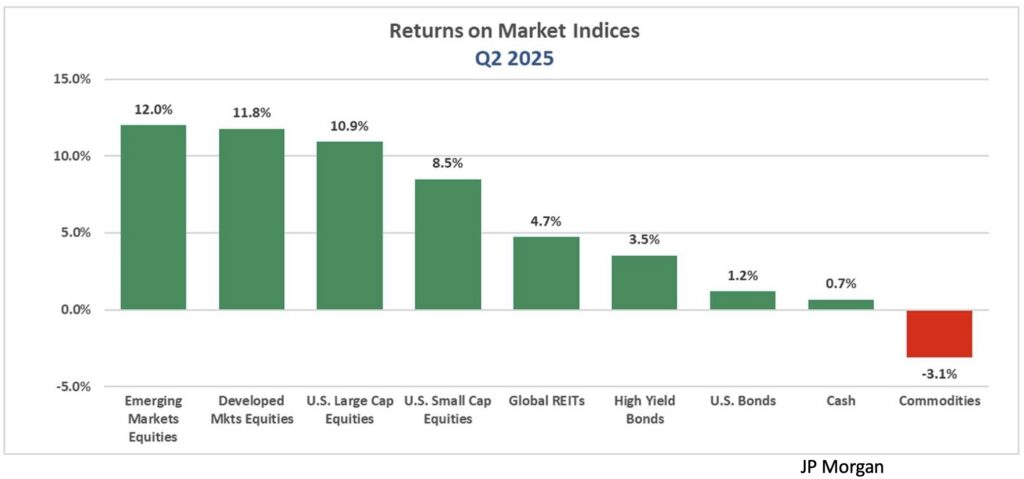
In a calendar quarter labeled by one financial journalist as “…historic and tumultuous”i most major market indices managed to produce positive returns:
President Trump’s executive orders on tariffs (April 2, aka “Liberation Day”) triggered a sharp revaluation of equity markets as analysts attempted to parse the many potential impacts of the new tariff regime. Over the subsequent weeks, analysts began to question whether the announced tariffs would “stick” or if President Trump might relax proposed levies during trade negotiations. Investors grew less pessimistic about the impact of tariffs and by mid-May the SCP 500 Index posted a slightly positive return for the year.
Escalation of the Russia/Ukraine war, continuation of the Israeli/Palestinian conflict in Gaza, and the emergence of direct hostilities between Israel, Iran, and the United States each created near-term risk events for financial markets (especially in crude oil prices) in Ǫ2. That financial markets seemed to absorb these risk events without systemic threats arising is variously attributed to the underlying resilience of capital markets, the hope that these conflicts might be short-lived, and the tendency of U.S. consumers—noted in the University of Michigan’s June consumer surveyii—not to connect conflicts in the Middle East with the U.S. economy.
Business sentiment remained cautious in Ǫ2 as owners and corporate executives curtailed plans for capital investment and hiring. Outside the U.S., anti-American sentiment prevailed and President Trump’s trade proposals heavily influenced the direction of politics and elections in several major countries (e.g., the election of Mark Carney as Canada’s PM).
The Federal Reserve held its short-term policy rate steady in Ǫ2 (in a target range of 4.25-4.50%) despite pressure from the White House to lower interest rates. Yields on the 10-Year U.S. Treasury Note—a key benchmark in the pricing of numerous fixed income, mortgage, and options markets—fluctuated dramatically in April (downward) and in the first half of May (upward) but closed out the 2nd Ǫuarter at roughly the same yield as it had started the quarter.
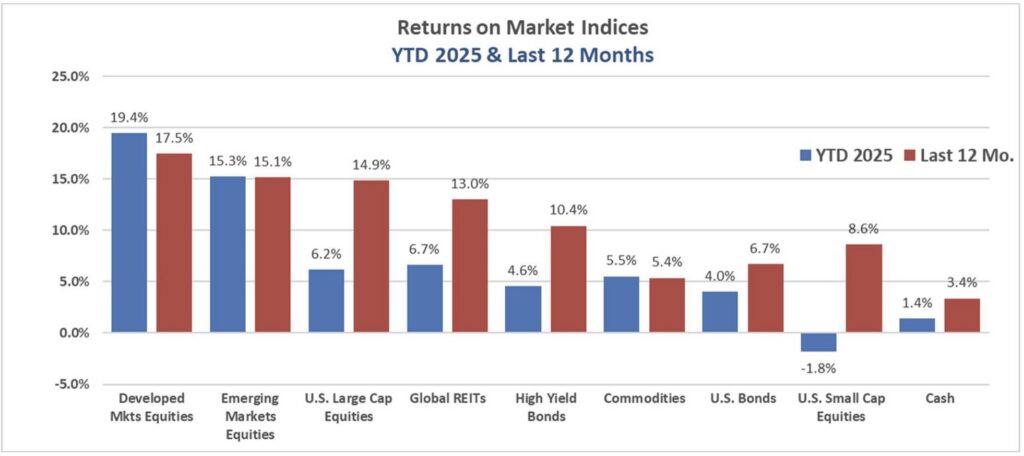
Rarely has investor pessimism (as expressed to us directly and frequently noted in the financial press) been so prevalent as in the first half of 2025, making Year-to-Date 2025 and Last 12 Months returns a pleasant surprise to many:
Market Outlook
Having rebounded strongly in May/June, most equity markets now appear fully valued based on most historical valuation metrics and current market risks.
- The promise of Artificial Intelligence (AI) to spur productivity growth and enhance corporate profits is counterbalanced by lingering uncertainty over tariffs, global trade, and competition from China.
- The recently passed tax and spending legislation (Trump’s “Big Beautiful Bill”) adds near-term fiscal stimulus through additional government spending which—while supportive to growth in the short run—elevates concerns over long-term government debt levels.
- Multiple interest rate cuts by the Federal Reserve—were they to materialize in Ǫ3/Ǫ4 2025—might reduce short-term borrowing costs for some households and businesses, but there is reason to believe that long-term interest rates might not respond similarly. Therefore, Fed rate cuts might not provide a strong tailwind to household spending, corporate investment, or equity valuations this year.
- Equity valuation metrics (e.g., Forward Price/Earnings ratio, Shiller CAPE Ratio, “Fed Model”, etc.) currently suggest a lower-than-usual equity risk premium versus bonds. In plainer English, the additional return expected by equity investors (versus bonds) for the additional risk assumed appears less than has historically been the case. This phenomenon may be more pronounced in U.S. equity markets than in Europe, Asia, or certain Emerging Markets (where equity valuations are substantially lower) but many U.S.-based investors will find it unappealing to realize significant capital gains in U.S. stocks to fund increased exposures in international equities.
Likewise, bond markets appear fairly-to-fully valued at present with current yields on intermediate maturities adequately compensating investors while yields on long-dated bonds provide little incentive to substantially lengthen duration (i.e., increase interest rate risk).
- As described above, the likelihood of materially more accommodative Fed monetary policy during the remainder of Fed Chair Powell’s term (which expires May 2026) is slim, absent some unforeseen extraneous risk event in the interim.
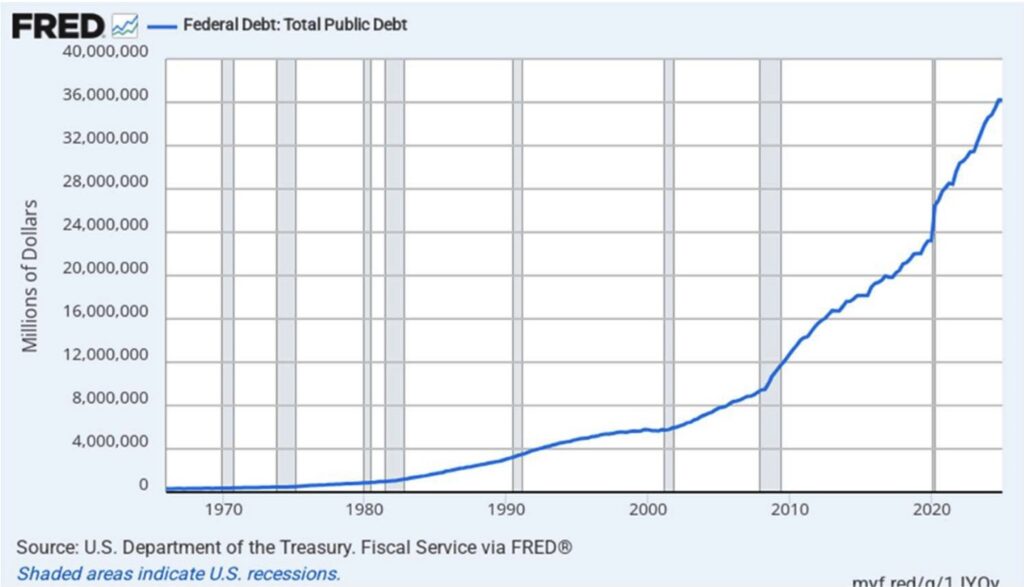
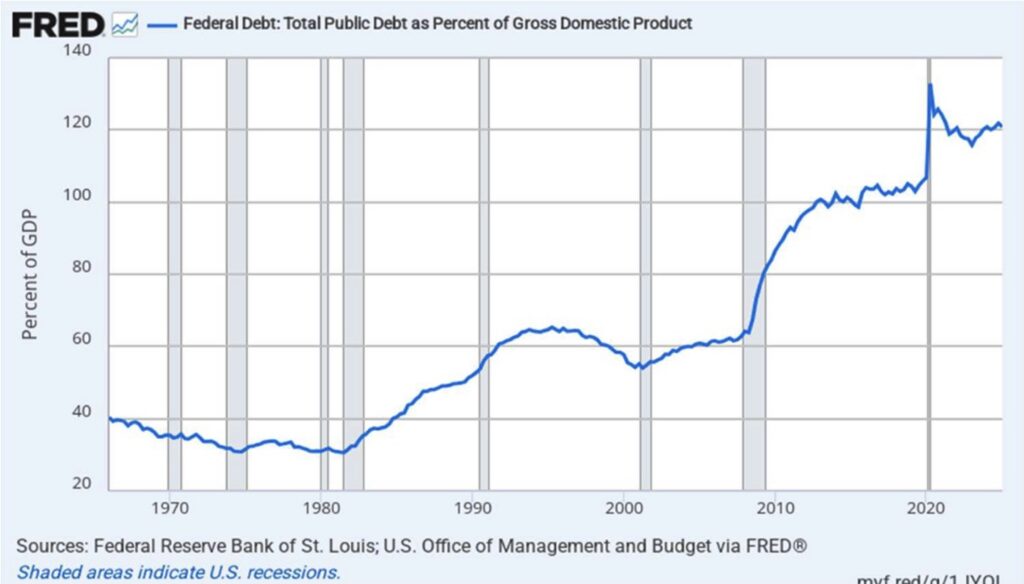
- Financial markets have (finally) awakened to the risks relating to the U.S. budget deficit and accumulated debt outstanding including potential supply/demand and liquidity imbalances in Treasury markets and the likelihood of declining U.S. creditworthiness over time. Two charts from the St. Louis Federal Reserve’s FRED database illustrate both the absolute and relative-to-income growth in government debt outstanding:
Several recently published works, including Paul Blustein’s highly praised King Dollariii, describe the seemingly unrestrained growth of U.S. government debt along with the Treasury’s “weaponization” of the US Dollar and Treasury markets via sanctions and increased reporting requirements. The consensus view, Blustein included, is that the U.S. Dollar is unlikely to experience a quick and dramatic loss of its preeminence but is highly likely to see its “exorbitant privilege” erode gradually over time as foreign investors rationally seek to diversify their USD-related holdings and risks.
Portfolio Positioning
Uncertainty, volatility, and risk are likely to remain features of the investment landscape during the second half of 2025 and beyond.
- We can hope that financial markets will be as resilient in the coming months as they have been in the first half of 2025, but we cannot be certain this will occur nor can we—as private investors—materially control the outcome.
- Taking the time to Review and reconfirm our financial goals, liquidity needs, and asset allocation targets are all within our control and constitute a better approach to portfolio management during “tumultuous” times. This process is a key component of Eton’s Goals-Based Allocation framework.
Reflecting on the first half of 2025, few periods have more ferociously tempted investors to abandon their strategic asset allocation targets and focus solely on tactical asset allocation or its more extreme cousin: market timing.
- Most of us—both private investors and professional asset managers alike—tend to overestimate our ability to foresee major market corrections, ascertain when stock and bond markets have hit their near-term bottoms, and reinvest our cash opportunely.
- Occasionally, market timing generates short-term, pre-tax profits, but those rare instances should be viewed as the exceptions which prove the rule that market timing generally reduces wealth over the long term.
- Trading costs, taxes, and the requirement that we be right twice (on the way out and on the way back into the market) favor long-term investors over aspiring market-timers.
We recommend that investors stay close to their goals-based asset allocation targets in core asset classes (cash, bonds, stocks).
- Sticking to our portfolio targets may be difficult at times, but the experience of YTD 2025 illustrates the benefit of the long-term perspective…even when markets are experiencing unprecedented types and levels of risk.
- In diversifying asset classes (hedge funds, private investments, real assets), one may rely on skilled managers to create return streams less correlated to core asset classes (i.e., alpha) by focusing on the near-term relative value of various securities one-to-another, niche sectors/companies lacking adequate investment capital, and assets likely to benefit from inflation or other risks that might be detrimental to core asset classes.
- In all our investing activities, liquidity management and diversification are key. The ability to sustain risk exposures during difficult markets—via adequate liquidity to fund near-term needs, prudent constraints on financial leverage, and rebalancing to avoid overconcentration—dramatically improves one’s chances of achieving long-term goals.