


EXECUTIVE SUMMARY
- In Q1 2026 financial markets rapidly shifted attention from worries over tariffs and the long-term impact of AI-related technologies on corporate profits and employment to the near-term effects of the war in Iran on energy prices, global supply chains, economic growth, and inflation. Volatility rose in both equity and fixed income markets.
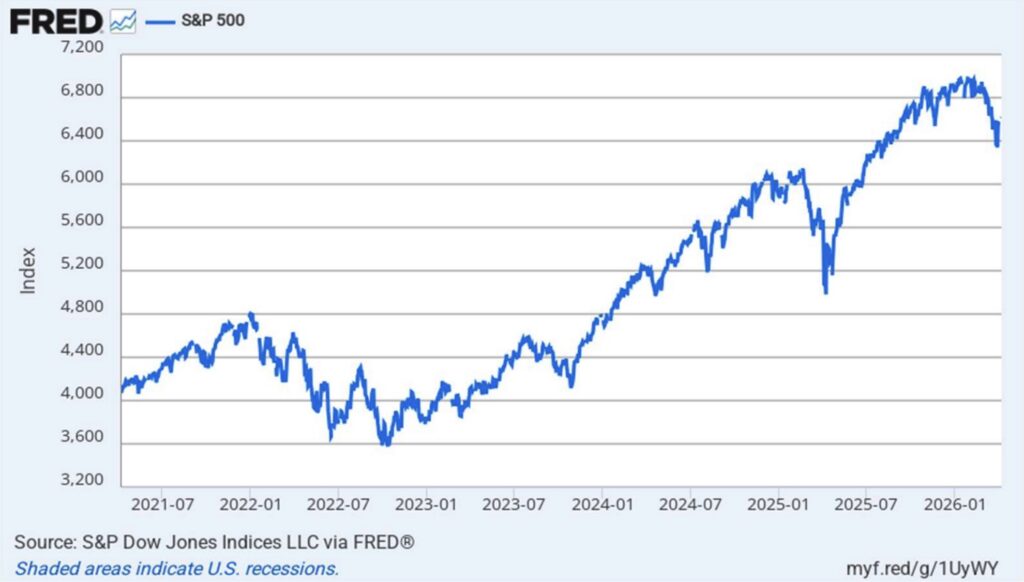
- Returns in public equity markets were generally negative during Q1, with U.S. stocks (S&P 500 -4.3%) once again trailing international equities (ACWI Ex-US – 0.7%). Investment-grade bond returns were roughly flat in Q1.
- Financial markets appear to be pricing-in a short-lived conflict in Iran. If that proves incorrect—or even if a brief conflict creates lasting disruptions to supply chains, production capacity, and prices—a sharper selloff in both stocks and bonds might be triggered later this year. This is now the primary near-term risk to financial markets.
- We continue to suggest multi-generational investors maintain broad diversification and trim overweights in public equities (where feasible given tax constraints) while maintaining ample liquidity to weather potential near-term market volatility.
Review of Q1 2026
In Q1 2026 financial markets rapidly shifted attention from worries over tariffs and the long-term impact of AI-related technologies on corporate profits and employment to the near-term effects of the war in Iran on energy prices, global supply chains, economic growth, and inflation. Volatility rose in both equity and fixed income markets and investors struggled to find “safe haven” assets in the wake of continued military conflict in the Middle East.
- For the quarter, U.S. large cap equities (S&P 500) were off -4.3% while U.S. small/mid cap stocks (Russell 2000) were similarly down -4.0%.
- International equity markets (MSCI All-Country World Index ex-U.S.) fared somewhat better, finishing the quarter down -0.7% and remaining ahead of U.S. large caps over the trailing 12 months (+23.7% ACWI Ex-US versus +17.4% S&P 500).
- In U.S. bond markets, coupon yields and price declines roughly offset each other to leave the Barclays Aggregate Bond Index flat in Q1 (0.0%) while the 12-month trailing return stands at +4.1%. In credit markets, many expressed their worry over growing issues in private credit/lending, prompting some investors to withdraw capital from the sector.
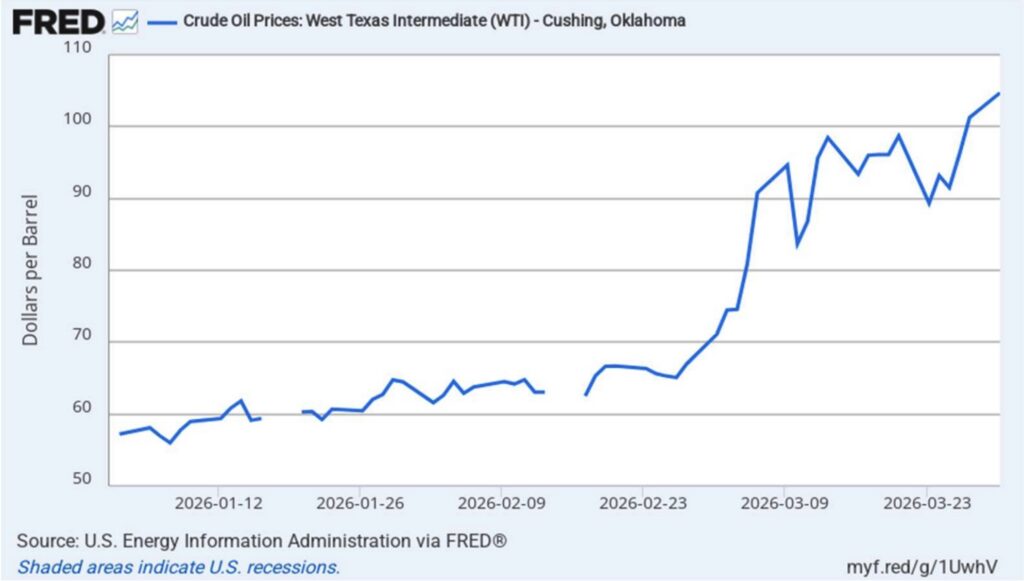
- Commodities prices were, unsurprisingly, the biggest beneficiary of constrained energy markets. The Bloomberg Commodity Index (weighted 35% to energy commodities) rose a whopping 24.4% in Q1 as crude oil prices nearly doubled during the quarter.
- Having peaked at $5,230 per ounce in late February, gold prices plummeted by more than 17% to $4,314 in late March. Such a sharp decline amidst a regional military conflict was unexpected and likely reflects profit-taking in gold positions by some investors and a preference to hold U.S. Dollars to manage contingent liquidity needs.
- The Dollar rose by nearly 2% for the full Q1 2026 against a broad basket of currencies and rose more than 3.5% from its low point in late January through quarter’s end.
Market Outlook
Though volatility in both equity and fixed income markets rose precipitously during Q1 with the commencement of the war in Iran, many have expressed surprise that stocks did not experience a more pronounced correction from peak levels such as was felt in the Dot.com bubble (2000-02), Great Financial Crisis (2008-09), or even the brief COVID correction (Spring 2020).
- Some have cited greater energy efficiency in both business and household sectors along with the lessening of U.S. dependence on imported oil as partly mitigating the economic effects of the war in Iran. The stimulative effects of increased defense spending are also cited, though this view ignores the expansion of government budget deficits and accumulated debt which results.
- Our perspective is that financial markets are assuming the military conflict and its impact on the global economy are unlikely to last beyond Q2 and this belief has effectively put a “floor” under stock prices and, correspondingly, a “ceiling” on long-term interest rates.
- If that assumption proves incorrect—or even if a brief conflict creates lasting disruptions to supply chains, production capacity, and prices—a sharper selloff in both stocks and bonds might be triggered later this year. This is now the primary near-term risk to financial markets.
If the duration of the war in Iran and its impact constitutes the primary near-term risk for investors, the persistence of above-target inflation, future trends in U.S. employment, and the path of monetary policy constitute secondary or intermediate-term risks.
- Disentangling the effects of the war in Iran on each of these important factors is an important, though extremely subjective and difficult, exercise. The likelihood of policy mistakes is high in this environment, as is the potential for sub-optimal capital allocation by businesses and investors.
Looking at the longer-term investment horizon, many questions remain unanswered regarding AI-related investments, including which sectors and individual companies will be winners and which will be losers, how data centers and other needed infrastructure will be financed and powered, and whether the path to sustainable profitability will justify current valuations. The war in Iran diverted attention from these topics in Q1, but uncertainty will remain over AI’s impact beyond the war’s conclusion.
Portfolio Positioning
In our January market outlook, we wrote:
“Tariff & inflation uncertainty, geopolitical instability, downside risks in equity valuations, and ongoing sovereign debt worries remain features of the investment landscape in 2026.”
Our list of investment risks from January remains essentially intact in early April, though clearly both the degree of urgency and level of severity associated with “geopolitical instability” has been greatly magnified by the war in Iran. Our prescription for the current situation remains unchanged, however, from January:
“Overall, we continue to suggest multi-generational investors maintain broad diversification and trim overweights in public equities (where feasible given tax constraints) while maintaining ample liquidity to weather potential near-term market volatility, should it occur.”
- The war in Iran has further complicated the path of monetary policy to be pursued by the Fed in 2026, suggesting little risk-adjusted reward for extending duration in fixed income portfolios. We also suggest caution in adding to private credit exposures given explosive growth in assets under management in this sector and related worries.
- The recent (post-quarter-end) rebound in equity markets may provide some investors with another opportunity to trim any remaining overweights in public equities.
- Precious metals and cryptocurrencies have experienced major bouts of price volatility in recent months. While these may serve as attractive diversifiers of investment return, investors should remain conscious of ongoing volatility in gold and cryptocurrencies as well as shifting correlations between these assets and traditional investments.