


EXECUTIVE SUMMARY
- Financial markets extended their strong performance through Ǫ4 2025 as outsized investment in AI and resilient consumer spending by higher-income households buoyed economic growth and corporate profit expectations, outweighing the effects of rising job losses and the Ǫ4 government shutdown.
- Equity returns were especially robust in 2025, led by international stocks after years of U.S. outperformance. The Federal Reserve cut its policy interest rate by an additional 25 basis points in December, helping Investment-Grade bonds deliver their best annual performance of the last five years (Barclays Aggregate, +7.3%).
- Market forecasts indicate near-unanimity on the primary risk facing equity investors: is AI in “bubble” territory and, if so, what might trigger its bursting? Longer-term risks include geopolitical instability in multiple regions, the impact of tariffs on growth and inflation, and when global bond investors might force a “reckoning” in overextended sovereign debt markets.
- We continue to suggest multi-generational investors maintain broad diversification and trim overweights in public equites (where feasible given tax constraints) while maintaining ample liquidity to weather potential near-term market volatility.
Review of Ǫ4 and 2025
Despite its rocky start, the year 2025 produced positive returns across nearly all major asset classes: stocks, bonds, precious metals, REITs, and cash. Equity returns were especially robust in 2025, led by international stocks after years of U.S. outperformance. Both Developed Markets (MSCI EAFE, +31.2%) and Emerging Markets equities (MSCI EM, +33.6%) outperformed U.S. stocks (SCP 500, +17.9%).
Worries over impending tariffs and Chinese AI developments drove down stocks in early 2025—a trend accelerated by President Trump’s “Liberation Day” tariff announcement on April 2. The selloff reached its nadir a few days later, April 8, at which point the SCP 500 was off approximately -15% for the year-to-date. From that low point on April 8 through December 31, the SGP 500 rose a remarkable +37.4%.
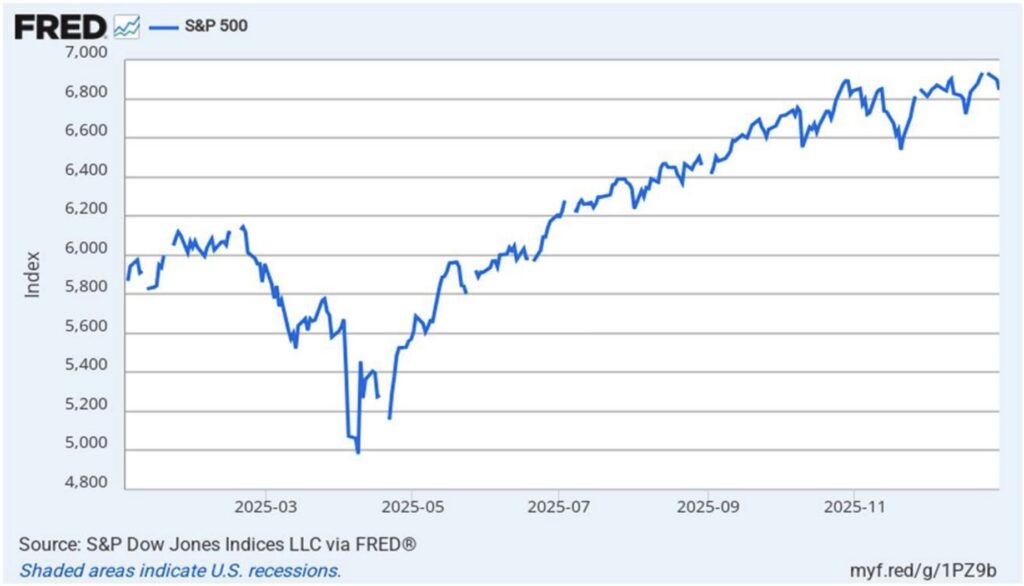
- What caused the dramatic turnaround? Certainly, the reduction in many of President Trump’s initial tariff proposals was partly responsible, as were the Fed’s interest rate cuts. Yet no single factor compares in impact to the surge in spending, investment, and anticipated earnings related to Artificial Intelligence (AI).
- We previously noted The Economisthad estimated nearly $400 billion would be invested in 2025 on infrastructure needed to run AI models and “…by the end of 2028 the sums spent worldwide on data centres will exceed :3 Tr.”i
- Analysts estimate that as much as one-fourth of recent U.S. economic growth (Real GDP, +4.3% annualized thru Ǫ3) is directly attributable to AI-related investment, primarily by the so-called hyperscalers (e.g., Alphabet, Amazon).
- Burgeoning demand for data centers also spurred real estate development in many geographical areas, created a boom in electric power generation, and aided the materials and construction sectors.
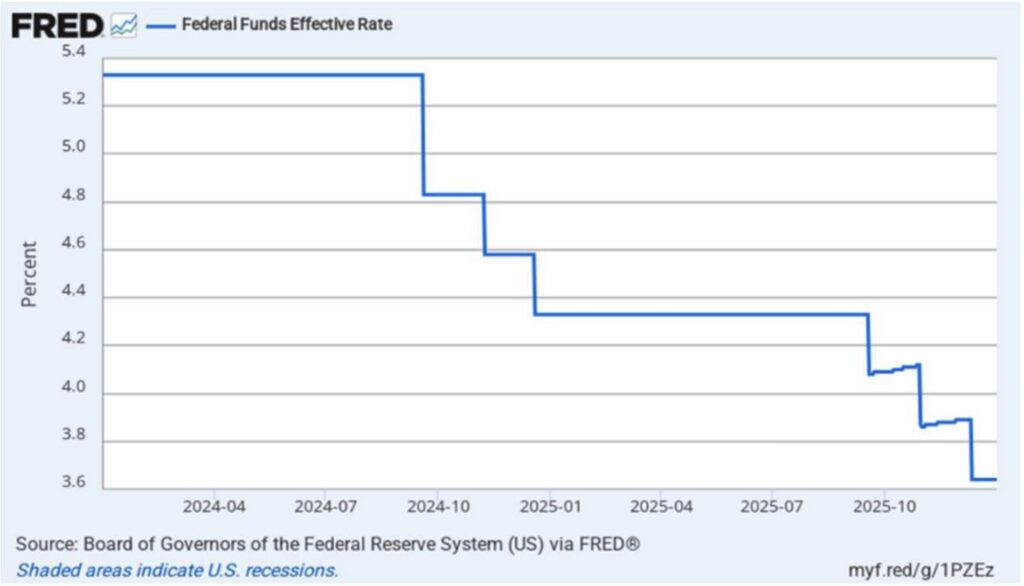
Separately, the Federal Reserve cut its policy interest rate by 25 basis points on three different occasions in 2025, continuing its efforts to bring the policy interest rate from restrictive back to neutral. At year-end, the Federal Funds target rate stood at 3.50 – 3.75%, with many disagreeing on whether additional rate cuts would be forthcoming in 1H 2026.
Market Outlook
The general health of the U.S. economy appears less in doubt than at this time last year, due partly to lower interest rates, fiscal stimulus (e.g., tax cuts, “Warrior Bonus”), and lower tariffs than expected. However, uncertainty remains high in financial markets around inflation’s path, how tariff policy might be impacted by Supreme Court decisions, and the ever-changing plethora of geopolitical tensions and conflicts. Additional risks include:
- Equity valuations
- We maintain that the benefits of AI will be tangible and widespread, but over- investment may drive down expected returns to some capital providers.
- Valuations on companies in the SGP 500 appeared stretched, as indicated by the Shiller CAPE Ratio (Cyclically Adjusted Price / Earnings) hovering around 39-40 times earnings versus its long-term average level of 31-32. By comparison, at their Dot-Com era peak the CAPE ratio stood at approximately 45 times earnings.
- Whether the recent surge in equity valuations is analogous to the Dot-Com bubble is hotly debated. Nearly all agree, however, that AI remains a driving force in near-term equity returns.
- Interest rates G credit markets
- Further interest rate cuts by the Fed—should they occur in 2026—are unlikely to reduce long-term interest rates materially, and therefore may provide scant boost to consumer spending, housing, or equity valuations.
- Growth in government debt (Federal Debt Outstanding, $38.5 Trillion) is likely to anchor longer-term rates at higher levels, as will heightened demand for borrowing to fund large-scale AI-related projects.
- Trump’s appointment of a new Fed Chair in 2026 also fuels uncertainty regarding interest rates, credit markets, and Fed independence.
Portfolio Positioning
Tariff G inflation uncertainty, geopolitical instability, downside risks in equity valuations, and ongoing sovereign debt worries remain features of the investment landscape in 2026.
- The first weeks of 2026 suggest equity markets may have further to run before analysts can judge accurately the effect of AI-related spending on corporate profits.
- Further Fed easing may fall short of expectations in 2026, suggesting little incentive to extend duration in fixed income portfolios. We also suggest caution in adding to private credit exposures given explosive growth in assets under management.
- High valuations in public equity markets may bolster returns in mature private equity investments in 2026, owing to a stronger IPO market and rebound in MCA levels from 2023-24 lows.
- Precious metals and cryptocurrencies continue to attract investors worried about debasement of fiat currencies and global instability. Investors should note high entry points (Spot Gold Dec 31, $4,318/oz) and the potential for near-term volatility (Bitcoin Ǫ4, -28%) when considering these assets for their portfolios.
Overall, we continue to suggest multi-generational investors maintain broad diversification and trim overweights in public equites (where feasible given tax constraints) while maintaining ample liquidity to weather potential near-term market volatility, should it occur.