


Equity and bond markets have experienced a significant rise in day-to-day volatility over the last two weeks as indicated by the change in the VIXi and MOVEii indices:
| Index | Measuring | Feb 19 | Mar 5 | % Change |
| VIX | Implied volatility in S&P 500 stocks | 15.27 | 23.98 | +57.0% |
| MOVE | Implied volatility in U.S. Treasury yields | 83.86 | 104.32 | +24.4% |
More familiar measures corroborate the rise in market volatility: since reaching an all-time high on February 19, the S&P 500 has fallen by nearly 5% and six of the so-called “Magnificent Seven” mega-cap technology stocks currently sit below their January 1 market values. One of the top performers of the last two years—chipmaker NVIDIA Corp—has seen its stock price decline by more than 20% since its early-January high. Small and mid-cap stocks (Russell 2000) have also fallen by more than 5% since the beginning of the year.
Meanwhile, the yield on the benchmark 10-Year Treasury note—having risen dramatically from its early-September low (3.62%) to its mid-January high (4.80%) on strong U.S. economic data, optimism regarding Trump’s second term, and continued worries about inflation—declined dramatically to 4.13% in early March. While this latest decline in yields is good for bondholders (since bond prices move inversely with yields) and is potentially beneficial to home buyers and other borrowers, the swift fall in yields suggests investors have shifted their outlook and now expect slower economic growth and desire more defensive or “safe haven” assets.
It’s not uncommon for equity markets to experience pullbacks. In fact, since 1928 stock prices have declined by 5% or more roughly three times per year, on average, and have corrected by 10% or more roughly once per year. Our January newsletter noted that U.S. large-cap equity valuations were near the top-end of their historical ranges by various measures (e.g., Shiller CAPE ratio) and that the U.S. equity market was “...exceptionally top heavy at present.” We also suggested that the certain stocks were perhaps engulfed in the “frenzy phase” around Artificial Intelligence (AI). Regarding bond markets, we noted the ever-growing government debt and “…lack of a credible debt reduction plan by government leaders” as a driver of future bond market volatility.
Yet some portion of the recent volatility in financial markets can be attributed to what we might label policy volatility, that is, week-to-week and even day-to-day changes in proposed policies on international trade/tariffs, government regulation of business and finance, public sector employment, the tax code and related enforcement practices, and how best to conclude ongoing military conflicts in Eastern Europe and the Middle East. Whatever the latest policy proposals, some will view them as beneficial and long overdue while others will see them as damaging or even unconscionable. The temptation for investors—on both ends of the political spectrum—is to respond to near-term policy volatility by making equally frequent adjustments in our portfolio asset allocation. Unless financial goals, time horizons, or risk tolerances have changed in the interim, such a reactionary approach to investment management is unlikely to preserve or grow wealth over time.
Some investors may wonder whether their tolerance for risk ought rightly to change during a period of volatility in financial markets and government policy such as we are currently experiencing. This is understandable, given the breadth of risks and their potential impact on investment returns. To help organize our thoughts and improve our portfolio decision-making, we have created the Matrix of Major Portfolio Risks below in which we categorize each risk according to its type (Financial Markets vs. Policy-Related) and time horizon (Near-Term vs. Long-Term):
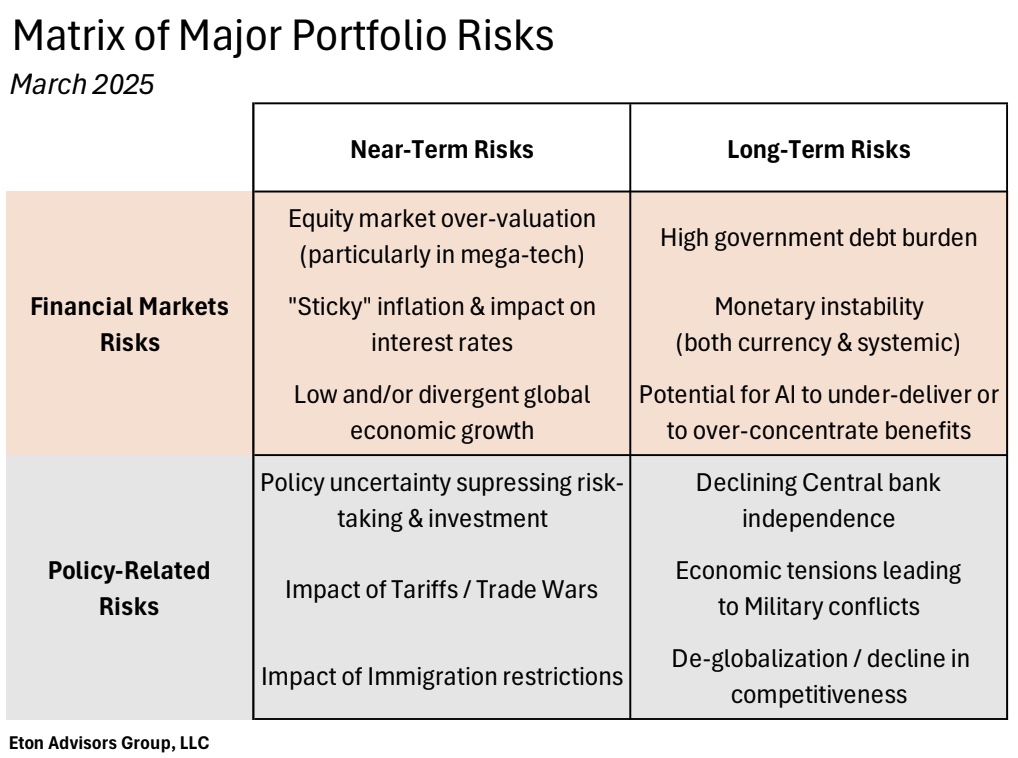
The list of Risks in the matrix above is certainly not exhaustive and is almost certain to have evolved by the time you read this newsletter. We believe, however, that several implications for goals-based investors should remain intact:
- Near-Term Risks, whether of the Financial Markets or Policy-Related type, can be mitigated by holding a sufficient portion of our portfolio in liquid, lower-volatility assets such that we can weather near-term market, political, or geopolitical storms without needing to sell assets at depressed prices. What constitutes “a sufficient portion” of a portfolio to be held in defensive assets such as cash, investment-grade bonds, and lower volatility hedge funds is dependent on each investor’s financial goals and annual rate of spending.
- Longer-Term Risks, such as the degree to which the U.S. government’s $36 Trillion indebtedness constrains economic growth and capital formation or the potential for various forces to contribute to a gradual decline in U.S. competitiveness, are best mitigated through broad diversification across Growth-Oriented and Inflation-Protecting asset classes, sub-classes, strategies, and managers. For investors with especially long, multi-generational time horizons the greatest risk is perhaps that investors rotate their portfolios out of risk assets and forego the upside optionality which tends to benefit investors in public equities, private equity, and real estate through economic growth, technological and business innovation, and market competition.
- The goals-based investment framework suggests that clients revisit their goal structure periodically and take note of the evolving mix of short-term and longer-term funding requirements therein. Long-term goals eventually become short-term goals through the passage of time and portfolio allocations should reflect this changing mix. Allocations to Growth-Oriented Assets and Inflation-Protecting Assets will require periodic rebalancing reflecting their respective rates of growth in the interim. Certain asset sub-classes, strategies, and managers will proceed through their own life cycles and naturally require reallocation.
In short, we recognize that the current environment is rife with uncertainty and volatility. The best approach, in our opinion, is to proactively and methodically review asset allocation targets relative to goals and time horizons rather than reacting frequently to the most recent market moves or policy proposals.