
KEY TAKEAWAYS
- A resurgence in energy prices, rising real interest rates, and questions around long-term AI-related growth estimates coalesced in the Third Quarter 2026, leading to muted equity returns and lower bond prices.
- For the quarter, U.S. large cap equities (S&P 500) were up +2.3%, while the tech- oriented NASDAQ 100 rose +0.6%. International stocks were relatively flat in Q3 (+0.5%, MSCI ACWI ex-U.S.). In fixed income, the benchmark Bloomberg U.S. Aggregate Bond Index fell -3.5% in Q3, leaving it at a net loss (-2.9%) for the Year to Date.
- Looking ahead, the uncertain paths of energy prices, overall inflation, and interest rates remain material sources of risk for investors, as do ongoing geopolitical conflicts and near-term political uncertainties.
- The breadth and interrelated nature of current risks continue to suggest investors maintain broad diversification and trim portfolio overweights versus their strategic targets, where feasible given tax constraints and overall portfolio considerations. Maintaining adequate liquidity to fund near-term goals is also appropriate in the current environment.
Review of Q3 2026
Financial markets entered the third quarter focused largely on geopolitics and the AI capital spending boom, but attention shifted toward a more fundamental question: How much additional capital are investors willing to lend to governments and corporations, and at what price? Rising long-term interest rates, declining bond prices, weakness in more interest-rate-sensitive segments of the equity market, and the Federal Reserve’s resumption of tightening all reflected that shift.
For the quarter, U.S. large cap equities (S&P 500) were up +2.3%, while the tech-oriented NASDAQ 100 rose +0.6%. After an encouraging broadening of leadership in the first half of the year beyond AI-related large cap technology stocks, Q3 reverted to narrow leadership by those companies, while U.S. small/mid cap stocks—more sensitive to rising interest rates—were down materially (-7.2%, Russell 2000). International stocks were relatively flat in Q3 (+0.5%, MSCI ACWI ex- U.S.).
In fixed income, the benchmark Bloomberg U.S. Aggregate Bond Index fell -3.5% in Q3, leaving it at a net loss (-2.9%) for the Year to Date. Increased bond issuance by both sovereign and corporate (AI-related) borrowers and longer-term fiscal sustainability concerns drove up real interest rates, reinforced by the Fed’s 0.25% rate hike in September, leaving nominal rates at 20-year highs for certain bond maturities.
Gold prices also remained relatively flat in Q3, while the broader Bloomberg Commodity Index surged once more (+16.2%). The U.S. Dollar Index, which measures the nominal value of U.S. currency against a broad basket of global trading partner currencies, remained relatively flat for the period. Inflation persisted above the Fed’s 2.0% annual target, with the Consumer Price Index (CPI) and Core Personal Consumption Expenditure (PCE) indicating year-over-year inflation of +3.4% and 3.0%, respectively, through August.
Market Outlook
A resurgence in energy prices, rising real interest rates, and questions around long-term AI-related growth estimates coalesced in the Third Quarter 2026 to produce muted investment returns. These factors remain among the primary sources of economic and market risk in Q4 and early 2027:
- Energy Prices: Volatility has been extreme in crude oil prices over the first nine months of 2026, with West Texas Intermediate (WTI) beginning the year at less than $60 per barrel, rising to more than $100 in April, then falling below $70 in July. By mid-September, the price of WTI had risen back above $100 per barrel, and the U.S. average price of gasoline well exceeded $4.00 per gallon.
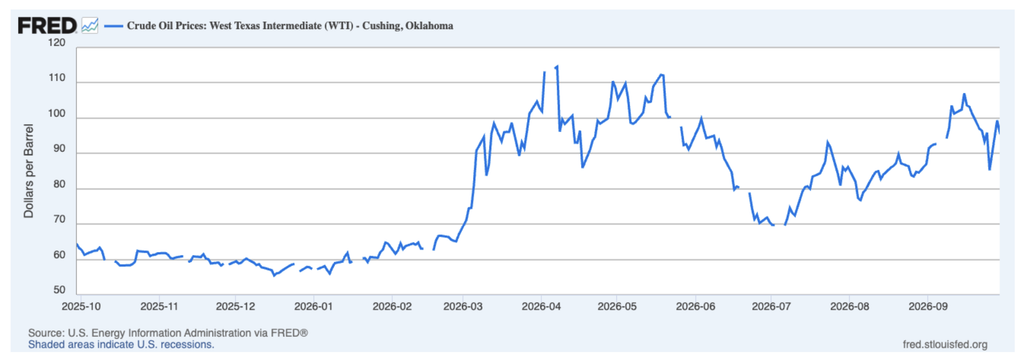
Both the absolute level of current energy prices and their recent volatility may negatively affect consumer confidence, spending, business profitability, and even mid-term-voter attitudes, all of which could impact financial markets already stretched thin.
- Real Interest Rates: Over the last 15 years, the level of “real” interest rates (i.e., the nominal rate of interest paid by the borrower minus the expected rate of inflation) has been low—and occasionally even negative—as the Federal Reserve suppressed interest rates to near-zero levels in an effort to stimulate risk-taking and investment by consumers and businesses. In recent quarters, however, real rates have increased rather dramatically, raising the net cost of borrowing to 21st-century highs.
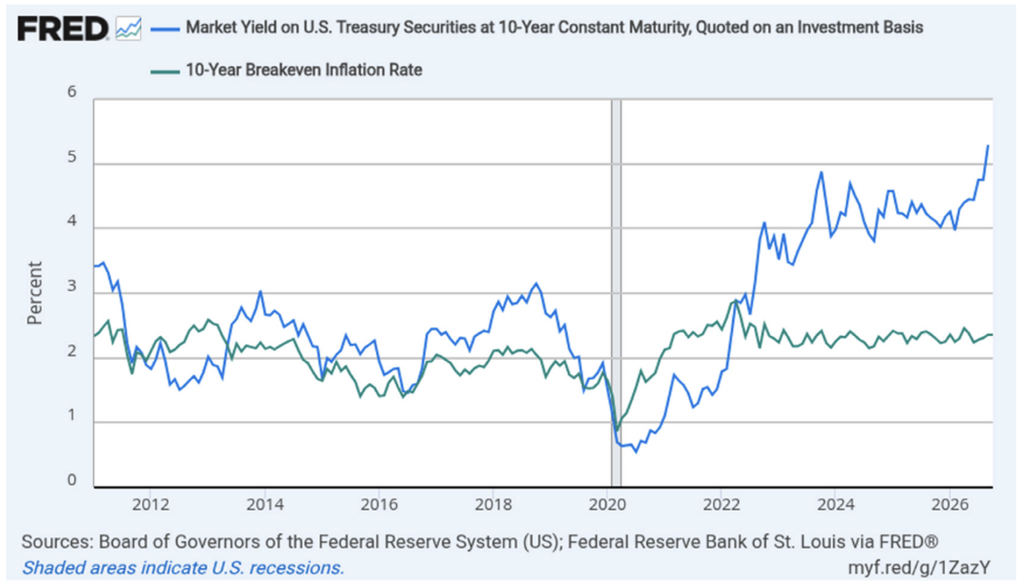
This recent spike is attributable to the confluence of several factors: increased borrowing needs by the U.S. Government to fund current-year deficits and refinance the nearly $40 trillion of accumulated debt; the enormous capital requirements of AI-related businesses to build out data centers and other infrastructure needed to meet anticipated AI demand in the coming decades; longer-term fiscal sustainability concerns; and uncertainty surrounding inflation and Fed policy moves over the next 12-18 months. These concerns are not unique to the United States, as rising debt burdens and debt-servicing costs across developed economies continue to place upward pressure on global borrowing costs.
From the borrower’s perspective, the net cost of financing has certainly risen, but from the perspective of a potential investor in bonds, higher nominal and real interest rates leave bonds looking more attractive than at any point this century…though not without volatility and risk.
- AI-related Growth: We noted last quarter that AI’s potential to expand corporate revenue growth and profit margins remains the primary positive force in the current investment environment. Yet as capital flows into AI-related projects in exponentially greater quantities, unanswered questions also proliferate:
- To what extent will investment returns on AI-related investments be diluted by the deluge of investor capital?
- How does surging demand for capital for AI-related projects affect broader capital markets (e.g., long-term bond yields)?
- Which companies will be the winners and which the losers of the AI revolution?
- Will overbuilding occur in data centers, or will state & local constraints lead to underbuilding of much-needed AI infrastructure?
- Given the role of AI-related investment in propelling U.S. GDP growth, how and to what extent will GDP suffer when AI spending inevitably slows or declines?
In short, the U.S. consumer continues to spend liberally while U.S. business continues to invest (largely in AI-related projects). However, consumer spending has recently outpaced income growth, pushing the saving rate lower and raising questions about the durability of that spending. Consumer spending and capital investment together comprised more than 80% of U.S. GDP in 2025. If high energy prices and interest rates persist into 2027 and AI-spending slows or declines, earnings growth may fall short of consensus expectations and broader economic momentum may begin to fade. Such a slowdown could serve to normalize energy prices and interest rates, but at a potentially severe near-term cost to the housing sector, highly leveraged borrowers, and public equity markets.
Portfolio Positioning
We continue to emphasize broad portfolio diversification—across asset super-classes, asset classes & sub-classes, investment strategies, and managers—as the only reliable and sustainable way to deal with the current environment of both opportunity and risk. Under that general framework, we offer several specific considerations for multi-generational, goals- based investors:
- While rising interest rates have led to losses for investors in intermediate and long-term bonds, current yields are quite attractive relative to the experience of the last 20 years, with the yield on the 5-Year U.S. Treasury exceeding 5.0% (as of 7 Oct). Rebalancing to bring fixed income levels back to strategic targets may be prudent given these more attractive yields.
- Public equity markets—especially U.S. large cap—have continued to set new record highs in the closing days of Q3 and opening days of Q4. To the extent that individual portfolio allocations to equities are materially above their strategic targets, we suggest trimming those overweight positions (where feasible given tax constraints). In planning for this portfolio rebalancing, investors should remain mindful of the potential impact of mid-term elections on equity market volatility.
- Recent large-scale IPOs suggest an improved exit environment for pent-up private markets, though there remains a significant backlog of companies seeking investor liquidity or more permanent sources of capital. M&A activity was strong in the first half of the year but cooled in Q3 as interest rates rose. We recommend each of our client families examine their specific liquidity requirements and resources when considering new or follow-on commitments to private investments given the ongoing constraints on liquidity and distributions to Limited Partners. We also remain attentive to underwriting standards and liquidity assumptions within private credit markets given their rapid growth in recent years.
By maintaining broad portfolio diversification and ample liquidity, we can remain focused and avoid the wealth-destroying behavioral tendencies of many investors during periods of uncertainty and volatility in geopolitics, the economy, and financial markets.